
Sales & Operations Planning (S&OP) is not just another buzzword—it’s a transformative business management process that integrates sales, operations, and financial planning. For Canadian manufacturers facing complex supply chains, labour constraints, and market shifts, S&OP is the framework they need to scale smarter and stronger.
What Is S&OP and Why It Matters for Canadian Manufacturing
- Definition: S&OP is an integrated planning process aligning demand, supply, and financial planning to support executive decision-making with feasible and profitable plans (1).
- Scope: It provides horizontal alignment (across departments) and vertical alignment (from strategy to execution), ensuring consistent decisions at all levels.
Why this matters in Canada:
In a manufacturing sector sensitive to global supply pressures and domestic demand variability, Canadian businesses must be agile—coordinating across procurement, operations, sales, and finance to sustain growth. Establishing a S&OP cycle can be instrumental in diminishing the bullwhip effect.
What is the bullwhip effect
A concept common in supply chain management. It occurs when there is a significant variation, increase or decrease, in inventory levels. It pushes the other partners in the supply chain to adjust their levels, accordingly, thus adding increased pressure on the supply chain as even “small increases in demand can cause a big snap in the need for parts and materials further down the supply chain.” (2) Furthermore, “[…] the variabilities of an upstream site are always greater than those of the downstream site.”(3)
📚 To learn more on the bullwhip effect:
https://sloanreview.mit.edu/article/the-bullwhip-effect-in-supply-chains
https://sloanreview.mit.edu/article/prepare-for-the-bullwhips-sting
Core Benefits of S&OP for Manufacturers
1. Higher Profitability & Inventory Control
- Improved forecast accuracy which leads to lower inventory costs and waste through balanced supply and demand planning.
- Supports financial goals through optimized allocation of materials and labour.
2. Improved Cross-Functional Collaboration
- Breaks down silos between departments — boosted coordination across sales, operations, finance, and marketing.
- Ensures that all teams are aligned and working toward reaching the same corporate objectives.
- Ensures that all teams are aware of upcoming volume of activity and can plan resources accordingly.
3. Better Decision-Making & Planning Flexibility
- Enables what‑if scenario planning and real‑time adjustments using modern S&OP tools.
- Streamlines monthly or rolling planning cycles for quick responses.
4. Scalable and Structured Process
- A cyclic, structured S&OP process encourages agility and resilience through regular reviews and planning.
5. Growth planning
- The visibility of the upcoming volume can help organizations identify needs for growth, such as adding a work shift, increasing the number of employees, adding more space, and even adding more production capacity in the form of an expansion or with sub-contractors.
How to Build a Robust S&OP Process in Your Organization
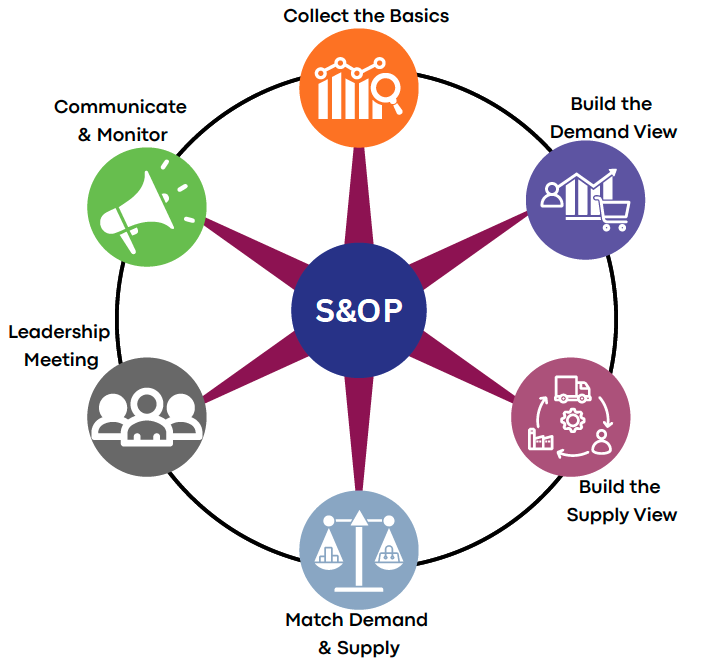
Here is our recommended step-by-step guide to implement S&OP.
- Collect the basics – Gather the essential numbers before the meeting. Start simple: sales, customer insights, suppliers, inventory, and available labour.
- Build the demand view – Turn raw data into a simple forecast. Combine numbers with sales insights, customer conversations, and market knowledge. Document your assumptions so everyone knows what’s behind the numbers.
- Build the supply view – Check what you can realistically deliver. Look at supplier capacity, machine capacity, labour availability, materials, and logistics. Don’t forget HR and financial planning.
- Match Demand & Supply – Compare demand with supply to see gaps or overlaps. Build “what-if” scenarios: overtime, outsourcing, shifting people, or prioritizing key customers. Connect each option to its cash flow and margin impact.
- Leadership meeting – Bring the summary to leadership for final approval. Keep the meeting decision-focused: what plan do we commit to, what trade-offs are accepted, and what risks are monitored? Record the decisions clearly.
- Structured decision-making – Share the plan with all teams and make sure actions are clear. Use simple dashboards or visual boards. Check progress weekly, track key metrics, and adjust quickly when reality changes.
Measuring S&OP Success: KPIs to Track
Use KPIs to ensure that the goals of the S&OP are being met. They can include:
- Supplier On-Time In-Full Delivery
- Supplier Performance
- Inventory turnover ratio
- Days of stock
- Total Inventory Cost
- Forecast accuracy
- On-Time In-Full Customer orders shipped out
You can also evaluate intangible benefits such as team alignment, process ownership, stakeholders’s participation.
Want to learn more about Inventory Management? Read our recent articles:
Demystifying Manufacturing Inventory
The Power of Inventory KPIs for Supply Chain Success
Q&A: FAQs on S&OP for Manufacturers
Q: How often should S&OP be conducted?
The 6-step approach described above is typically conducted monthly. If there is a period of high volatility, frequency can be increased. The operational side of the S&OP, following up on production objectives and reallocation of resources should be done at the very least weekly, if not daily, depending on the volume.
Q: What technology supports effective S&OP?
Cloud-based platforms with real-time analytics, collaboration tools, and what‑if simulation capabilities are critical. There are also more and more AI solutions that can provide assistance with forecasting and S&OP.
Q: What drives a successful S&OP team?
Collaboration, information quality, decision autonomy, and shared incentives and objectives are the strongest predictors of effectiveness.
Conclusion
S&OP is the strategic compass that helps manufacturers navigate growth—optimizing costs, aligning functions, boosting responsiveness, and sustaining profitability. By implementing a disciplined, measurable S&OP process with modern tools and cross-functional buy-in, manufacturers can scale with confidence in today’s dynamic environment.
Are you wanting to implement S&OP in your organization? Then, take a look at our FREE GUIDE “6 Steps to a Strong S&OP Process for SMEs“
About Veronica Marquez, M.Sc., CSSBB

Veronica Marquez is the Founder of Aristeío, a firm specializing in resilient execution systems for manufacturing, service, and public-sector organizations operating under pressure. She works with executive and operations leaders to strengthen governance, clarify decision rights, and surface structural execution risks before they disrupt delivery.
A certified Lean Six Sigma Black Belt with a Master’s degree in Operations Management, Veronica bridges operational rigor with system-level thinking. She was named one of the Top 50 Experts in Operational Excellence by PEX Network and ranked among the Favikon Top 200 Global Creators in Risk & Resilience.
Through her Resilient Execution Readiness Assessment, she helps leadership teams identify and address execution vulnerabilities early—before performance credibility erodes.
Reach out https://www.linkedin.com/in/veronicabm/
Sources:
(1) https://www.oracle.com/ca-en/scm/supply-chain-planning/sales-operations-planning/s-and-op/?utm_source=chatgpt.com
(2) Timothy Aeppel, The Wall Street Journal, 1994., cited on https://sloanreview.mit.edu/article/understanding-the-bullwhip-effect-in-supply-chains/
(3) Lee, Padmanabhan & Whang (1997) The Bullwhip effect in Supply Chain, MIT Sloan Management review.
📷 Canva AI