



Key Takeaways
- Usable capacity measures actual execution capability rather than just headcount, and it deteriorates unnoticed as organizations grow.
- Stable staffing does not ensure stable execution; hidden governance gaps cause performance issues that often go unrecognized.
- Weak signals of declining capability include longer decision cycles and increased reliance on individual intervention.
- Early intervention is critical; assessment of governance conditions can prevent degradation before it impacts performance.
- Improving visibility and governance design sustains usable capacity and enhances execution resilience under pressure.
Estimated reading time: 8 minutes
Table of contents
Executive Framing
Headcount is stable. Overtime is manageable. Open positions are not increasing.
Yet execution feels harder every month.
Decisions take longer. Problems require more intervention. Escalations arrive later. Supervisors spend more time coordinating work that previously flowed naturally.
Nothing appears broken. Control is.
Many operations leaders eventually ask the same question: If staffing has not changed, why is execution reliability declining?
The answer is often hidden in usable capacity.
Visible capacity measures resources. Usable capacity measures execution capability. The difference matters most under pressure.
A recurring pattern observed across operational environments is that organizations can maintain the same headcount while losing planning quality, coordination effectiveness, escalation discipline, operational visibility, and decision speed. Performance may remain acceptable for months. The underlying capability does not.
Control deteriorates before performance collapses.

Clear Definition
Usable capacity is the portion of organizational capacity that can reliably convert effort into execution outcomes under real operating conditions. It includes staffing, coordination quality, decision effectiveness, escalation discipline, planning integrity, and operational visibility. Headcount measures available resources. Usable capacity measures actual execution capability.
What Breaks First Under Pressure
Capacity Visibility
Most organizations measure availability.
Few measure execution health.
When leadership relies primarily on staffing levels, scheduled hours, or resource utilization, early capability deterioration remains invisible.
The risk is structural.
Governance systems conclude capacity is stable while execution capability quietly erodes.
Governance Clarity
Pressure exposes ambiguity.
Decision ownership becomes less clear. Priorities shift more frequently. Local workarounds replace governance discipline.
The organization appears flexible.
It is becoming harder to govern.
Decision Rights
Decision latency grows before failure appears.
Teams wait for approvals. Cross-functional disputes remain unresolved longer. Escalations move upward because authority boundaries are unclear.
Execution slows indirectly.
Escalation Discipline
Weak signals disappear first.
Operational risks remain local instead of moving through defined governance channels. Leaders receive fewer warnings even as complexity increases.
Problems compound when not made visible.
KPI Ownership
Metrics survive longer than capability.
Organizations often continue hitting targets by consuming coordination reserves, management attention, and employee effort.
Capability degrades before failure becomes visible.
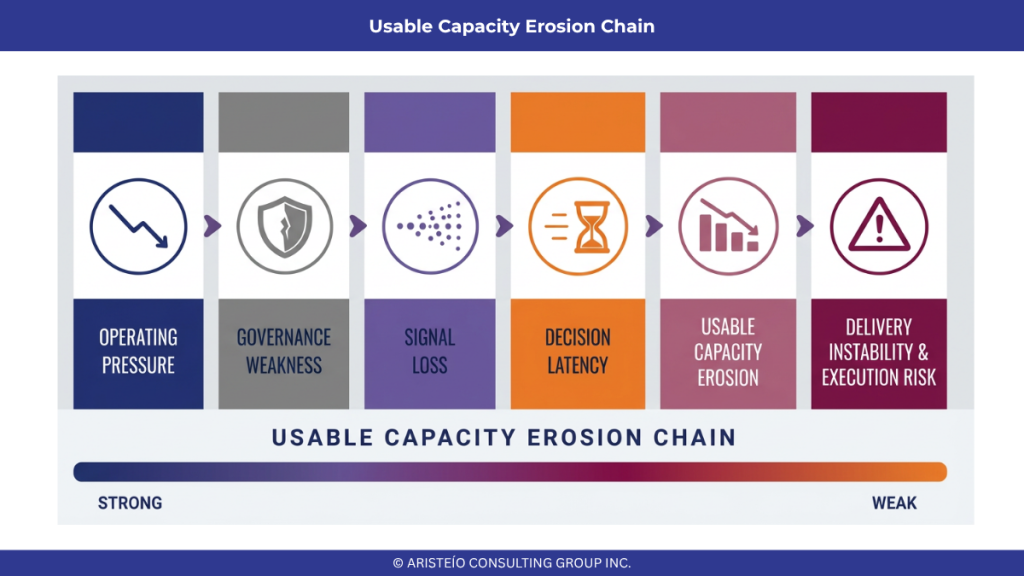
Governance & Ownership Failure
The most dangerous operational deterioration is rarely workload growth.
It is ownership dilution.
As organizations grow, responsibilities frequently expand faster than governance maturity. Accountability remains formally assigned, but practical ownership becomes fragmented across functions.
Issues wait for alignment.
Decisions wait for consensus.
Risks wait for visibility.
This creates a hidden governance gap where execution reliability depends increasingly on individual intervention rather than system design.
Stable staffing cannot compensate for weakening governance architecture.
The trade-off emerges clearly.
Organizations protect short-term throughput while slowly consuming capability integrity.
For a period, output masks deterioration.
Eventually, coordination costs become visible.
As organizations grow, governance throughput frequently becomes a hidden constraint on execution capacity.
Industry Illustration
Consider a growing manufacturing operation.
Headcount remains unchanged for twelve months. Throughput remains acceptable. Customer delivery performance remains mostly stable.
Leadership concludes capacity is healthy.
Meanwhile, planners perform more manual corrections. Supervisors spend more time resolving exceptions. Escalations increasingly bypass formal channels. Decision cycles lengthen. Variability grows.
No individual metric appears alarming.
Taken together, they indicate declining usable capacity.
The organization is not losing people.
It is losing execution capability.
Early Warning Signs
- Increasing operational surprises despite stable KPIs
- Longer issue-resolution and escalation cycles
- Rising dependence on individual heroics
- More reactive planning activity and schedule rework
- Growing variance between reported status and operational reality
Weak signals deserve governance attention.
What Leaders Commonly Misread
Many leaders assume stable staffing equals stable capacity.
It does not.
Staffing is an input.
Usable capacity is an outcome created by governance quality, decision effectiveness, visibility, accountability, and coordination discipline.
Organizations do not lose control because people disappear.
They lose control because capability deterioration remains invisible long enough to normalize.
Leaders cannot govern what they cannot see.
Stabilization Logic
Recovery begins with visibility.
Not activity.
Governance maturity improves when leaders can see how execution capability is changing before performance deteriorates.
This requires five conditions.
Governance Clarity
Define ownership boundaries.
Capacity Visibility
Measure execution health alongside resource availability.
Decision Loop Shortening
Reduce unnecessary escalation layers.
Risk Surfacing
Preserve weak-signal visibility under pressure.
Accountability Structure
Ensure responsibility and authority move together.
The objective is not greater control through bureaucracy.
The objective is stronger control through better governance design.
Visibility precedes correction.
Why Assessment Comes First
Intervention without diagnosis creates false confidence.
Organizations often respond to execution strain by adding resources, restructuring teams, introducing process changes, or increasing reporting requirements.
Those actions may address symptoms.
They rarely identify the underlying governance condition.
The Resilient Execution Readiness Assessment exists to create clarity before intervention.
It evaluates the structures that govern execution under pressure, including visibility, escalation discipline, accountability architecture, decision effectiveness, and operational resilience.
Diagnosis reduces guesswork.
Clarity improves decisions.
Governance determines whether deterioration compounds or is corrected.
FAQ
Usable capacity is the portion of organizational capability that can consistently deliver outcomes under normal and pressured conditions. It extends beyond staffing levels to include planning quality, decision effectiveness, accountability, visibility, and coordination. Structural insight: capacity is created by governance, not resources alone.
Execution often deteriorates because coordination quality, visibility, escalation discipline, and decision speed decline while headcount remains constant. Organizations may preserve staffing while consuming the governance conditions that support reliable execution. Structural insight: capability erosion often precedes workforce change.
Leaders should examine issue-resolution speed, escalation effectiveness, planning stability, decision latency, operational visibility, and dependency on individual intervention. These indicators reveal execution health earlier than traditional staffing metrics. Structural insight: execution capability produces better signals than resource counts.
Many governance systems emphasize outcomes more than conditions. Leaders continue seeing acceptable performance while weak signals remain fragmented across teams. By the time performance deteriorates, capability degradation may already be significant. Structural insight: visibility is a prerequisite for effective governance.
Call to Action
Many organizations begin strengthening execution only after visible performance problems emerge.
That timing is expensive.
The more resilient approach is to understand whether governance systems can preserve control before pressure exposes their limits.
The Resilient Execution Readiness Assessment helps leaders evaluate that question systematically.
Operational deterioration is not inevitable.
It is often a consequence of design conditions that remained invisible for too long.
Better visibility creates better governance. Better governance protects capability. Capability sustains execution under pressure.
About Veronica Marquez, M.Sc., CSSBB

Veronica Marquez is the Founder of Aristeío, a firm specializing in resilient execution systems for manufacturing, service, and public-sector organizations operating under pressure. She works with executive and operations leaders to strengthen governance, clarify decision rights, and surface structural execution risks before they disrupt delivery.
A certified Lean Six Sigma Black Belt with a Master’s degree in Operations Management, Veronica bridges operational rigor with system-level thinking. She was named one of the Top 50 Experts in Operational Excellence by PEX Network and ranked among the Favikon Top 200 Global Creators in Risk & Resilience.
Through her Resilient Execution Readiness Assessment, she helps leadership teams identify and address execution vulnerabilities early—before performance credibility erodes.
Reach out https://www.linkedin.com/in/veronicabm/
📸 Canva