



Executive Framing
Many organizations begin the year with more initiatives, tighter timelines, and more aggressive growth targets than the previous cycle.
At the same time, escalation pathways, decision rights, and prioritization mechanisms often remain unchanged. Approval layers are not redesigned. Governance forums are not restructured. Decision authority boundaries are not clarified.
Senior meetings begin to repeat the same unresolved topics. More decisions require executive intervention. Directors resolve issues informally to avoid visible disruption.
If strategic commitments increased, did governance capacity increase at the same pace?
When strategy outpaces capacity, execution drift begins at the governance level. Escalation cycle time increases. Decision turnaround time extends. Decision latency becomes visible in recurring agenda items and deferred approvals. Priority volatility rate rises as initiatives are re-ranked or paused. Teams compensate through additional effort rather than structural redesign. Over time, delivery stability weakens and growth strain intensifies.
This is a governance maturity constraint, not a motivation issue.
Clear Definition
When strategy outpaces capacity, the volume and complexity of strategic commitments expand faster than the organization’s escalation structure, decision rights, and prioritization mechanisms can process them. The result is rising escalation cycle time, longer decision turnaround time, and increasing priority volatility rate that conceal structural governance limitations.
What Breaks First When Strategy Outpaces Capacity
The structural failure points — capacity visibility, governance clarity, decision rights, escalation discipline, and KPI ownership — were defined in the previous article.
This article examines how those governance elements behave when strategic acceleration increases systemic load.
This condition manifests through increasing escalation cycle time, longer decision turnaround time, rising decision latency, and a growing priority volatility rate before delivery metrics decline.
Why Overload Rarely Appears First in Dashboards
Operational overload is frequently interpreted as excessive workload. In practice, it often originates in slow or unclear decision flow.
When approvals are delayed and trade-offs are not explicit, teams compensate. Directors intervene informally to prevent missed commitments. Delivery metrics can remain acceptable because experienced leaders absorb strain.
Escalation cycle time and decision turnaround time increase before output declines. Priority volatility rate rises as initiatives are adjusted to resolve conflicts.
Governance friction precedes visible performance deterioration.
Escalation Bottlenecks as Hidden Capacity Drains
Escalation bottlenecks reduce structural capacity by slowing the movement of decisions across the organization.
Each delayed decision produces idle execution time, rework caused by unclear direction, context switching across initiatives, and informal prioritization outside governance forums.
These effects accumulate across functions. As escalation structure becomes overloaded, human effort compensates temporarily. Over time, usable capacity declines because more time is spent resolving ambiguity than executing strategy.
When strategy outpaces capacity, governance throughput becomes the limiting factor.
Governance & Authority Misalignment
Execution degrades when accountability and authority are disconnected.
Directors may be responsible for performance targets but lack authority to resolve cross-functional constraints. Issues are escalated upward or negotiated laterally because decision rights are unclear. Escalation cycle time expands as decisions move vertically for interpretation rather than being resolved at the appropriate level.
As prioritization clarity weakens, priority volatility rate increases. Initiatives are paused, restarted, or re-ranked as competing interpretations of strategy surface.
Governance maturity determines whether complexity is absorbed structurally or pushed upward.
Industry Illustration
In high-growth manufacturing environments, product launches, customer commitments, and internal transformation initiatives frequently overlap.
Engineering decisions wait for cross-functional approval. Procurement escalations accumulate at senior levels. Operations leaders adjust locally to protect delivery metrics.
Throughput appears stable. However, decision turnaround time has increased and informal escalation channels carry critical trade-offs. Priority volatility rate rises across active initiatives.
The organization maintains output by absorbing structural strain rather than resolving it.
Early Warning Signs
Executives should monitor:
- Escalation cycle time increasing over successive review periods
- Decision turnaround time exceeding defined thresholds
- Recurring senior agenda items without closure
- Increasing priority volatility rate across active initiatives
- Growth in informal escalations outside defined pathways
These indicators signal governance constraint before delivery instability becomes visible.
What Leaders Commonly Misread
A frequent assumption is that overload reflects insufficient staffing.
Increasing headcount without redesigning escalation structure and decision rights increases coordination complexity. Decision latency persists within a larger system.
The primary constraint is governance throughput.
When strategy outpaces capacity, maturity of structure—not additional manpower—determines resilience.
Designing Governance to Sustain Acceleration
Execution stability depends on governance design and clarity of authority across levels.
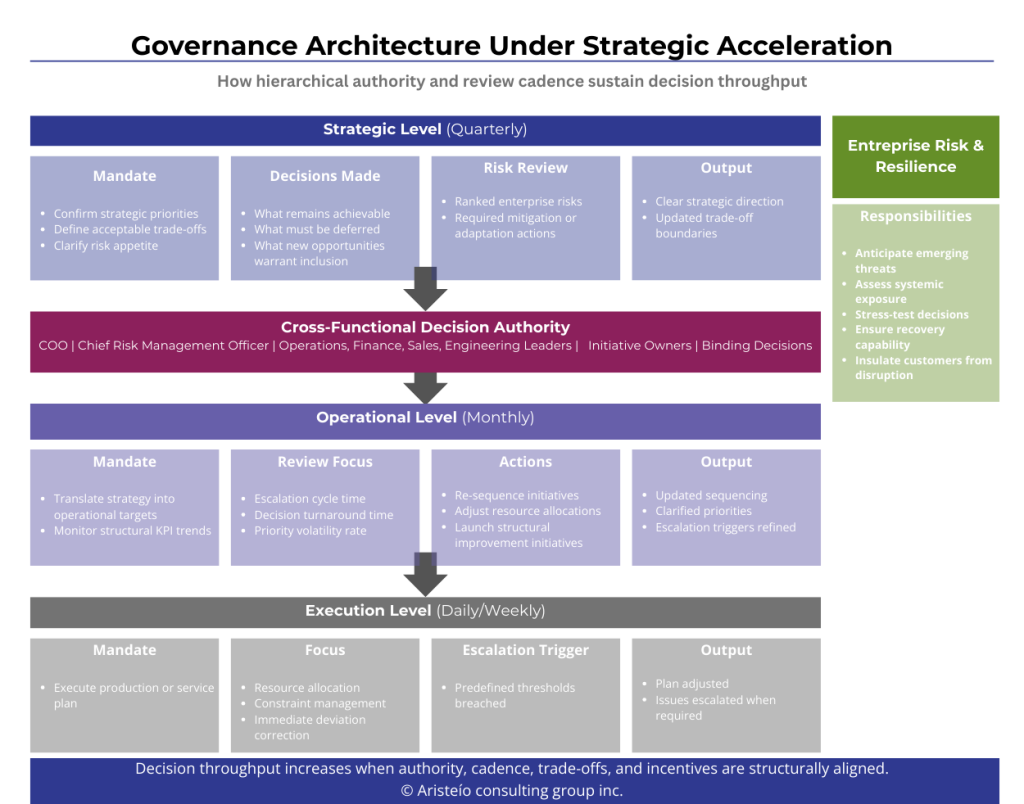
Hierarchical Decision Architecture
Decision speed is influenced by how clearly authority is structured and how consistently those boundaries are respected.
At the executive level, leadership defines strategic intent, acceptable risk exposure, capital allocation priorities, and major cross-functional trade-offs. These decisions establish what the organization will optimize and what it will sacrifice under pressure.
At the director level, strategy is translated into operational drivers, performance thresholds, sequencing logic, and resource commitments. Directors must apply executive trade-off logic consistently so decisions do not require repeated escalation.
At the supervisory level, daily execution is managed within predefined limits. Supervisors require explicit authority to act within thresholds and clear criteria that trigger escalation.
Cross-Functional Governance Forum
A formal cross-functional governance forum resolves structural conflicts, manages major reprioritization, and addresses issues that exceed defined authority levels.
This forum should include:
- Executive sponsor or COO– Holds authority over strategic trade-offs and risk appetite.
- Chief Risk Management Officer (or equivalent)– Identifies emerging threats, assesses systemic exposure, anticipates disruption scenarios, and ensures resilience mechanisms are embedded into operational design so customers are insulated from disruption where possible.
- Functional leaders (Operations, Finance, Sales, Engineering)– Provide data on constraints, commitments, operational limits, and financial impact.
- Initiative owners affected by the decision– Bring direct accountability and execution impact perspective.
Participants must bring decision rights within their domain. The forum exists to make binding cross-functional trade-offs based on shared data and risk visibility. It must operate on a defined cadence with documented decisions and follow-through mechanisms.
Clear stratification of authority reduces unnecessary vertical escalation and preserves executive capacity for strategic decisions rather than operational clarification.
Review Cadence Synchronization
Strategic planning typically operates on annual or semi-annual cycles, while operational conditions shift weekly and sometimes daily.
If review cadence does not reflect operational tempo, decision latency becomes embedded in the system. Issues accumulate between formal review moments, and reprioritization is delayed.
Strategic (quarterly), operational (monthly), and execution (daily or weekly) reviews must therefore be connected through defined objectives:
- Strategic review:Reassesses the viability of strategy, determines what remains achievable, identifies what is no longer realistic, evaluates emerging opportunities, and reviews ranked risks along with mitigation or adaptation actions.
- Operational review:Evaluates KPI performance, analyzes trends, examines unrealized goals, and identifies structural gaps that require corrective action or future improvement initiatives.
- Execution review:Reviews the production or service plan, reallocates resources, addresses immediate constraints, and corrects deviations before they accumulate.
Decisions and trade-offs made at one level must be translated formally into expectations at the next level within a defined time frame. Without this translation discipline, strategic intent and daily execution drift apart.
Predefined review triggers tied to performance thresholds or risk exposure enable adaptive realignment under pressure.
Trade-Off Logic and Incentive Alignment
Decision latency increases when strategic trade-offs are not defined in advance. When strategy outpaces capacity, unresolved trade-off logic becomes a primary driver of slowed decision throughput.
Executives must clarify acceptable compromises such as cost versus speed, margin versus service, or growth versus stability. When these parameters are explicit, lower levels can act without repeated escalation.
Directors must enforce sequencing discipline across value streams so local urgency does not override agreed strategic priorities. When trade-offs are renegotiated repeatedly, priority volatility rate increases and decision capacity is consumed.
Incentives must align with strategic intent. If performance metrics contradict declared priorities, escalation forums become negotiation arenas rather than resolution mechanisms.
KPI ownership must match decision authority at each hierarchical level. Structural alignment reduces escalation loops and preserves throughput.
When strategy outpaces capacity, hierarchical clarity, synchronized cadence, disciplined trade-off logic, and aligned incentives determine whether growth strengthens stability or amplifies fragility.
Why Assessment Comes First
Governance redesign requires objective visibility into structural constraints.
Before reallocating resources or adjusting reporting lines, leaders must determine whether escalation architecture, prioritization clarity, decision throughput, and review cadence can support current strategic commitments.
The Resilient Execution Readiness Assessment provides structured clarity under pressure. It evaluates escalation pathways, decision latency patterns, authority alignment, KPI ownership, and cadence synchronization.
This diagnostic approach accelerates governance maturity before visible breakdown occurs. It allows leadership to strengthen structural capacity proactively rather than responding reactively to failure.
Mature governance is deliberately engineered to sustain acceleration.
Executive Summary
When strategy outpaces capacity, governance throughput—not workforce effort—becomes the primary constraint on performance. Escalation cycle time, decision turnaround time, decision latency, and priority volatility rate deteriorate before delivery metrics decline. Sustainable acceleration depends on hierarchical authority clarity, synchronized review cadence, disciplined trade-off logic, and aligned incentives.
FAQ
How can I detect early execution drift if delivery metrics remain stable?
Monitor escalation cycle time, decision turnaround time, and priority volatility rate alongside traditional KPIs. If governance indicators deteriorate while delivery metrics remain stable, structural strain is developing upstream of performance when strategy outpaces capacity.
Why does adding staff often fail to resolve persistent overload?
If decision rights and escalation pathways are unclear, additional staff increase coordination demand. Governance friction expands with complexity. Structural clarity must precede capacity expansion.
What is priority volatility rate and why should executives monitor it?
Priority volatility rate measures how frequently active initiatives are re-ranked, paused, or restarted. Elevated volatility signals unstable prioritization logic and inefficient use of decision capacity.
Why should a structured assessment precede governance redesign?
Without structured diagnosis, leaders may adjust roles or resources without addressing root governance constraints. Identifying escalation and decision-flow weaknesses ensures redesign targets systemic limitations rather than symptoms.
Call to Action
If strategic commitments have increased and subtle governance friction is emerging, the issue is structural.
The Resilient Execution Readiness Assessment examines whether escalation architecture, prioritization logic, authority alignment, and decision throughput can sustain current strategy.
Execution stability is a function of system design.
When strategy outpaces capacity, governance maturity determines sustainable performance.
About Veronica Marquez, M.Sc., CSSBB

Veronica Marquez is the Founder of Aristeío, a firm specializing in resilient execution systems for manufacturing, service, and public-sector organizations operating under pressure. She works with executive and operations leaders to strengthen governance, clarify decision rights, and surface structural execution risks before they disrupt delivery.
A certified Lean Six Sigma Black Belt with a Master’s degree in Operations Management, Veronica bridges operational rigor with system-level thinking. She was named one of the Top 50 Experts in Operational Excellence by PEX Network and ranked among the Favikon Top 200 Global Creators in Risk & Resilience.
Through her Resilient Execution Readiness Assessment, she helps leadership teams identify and address execution vulnerabilities early—before performance credibility erodes.
Reach out https://www.linkedin.com/in/veronicabm/
📸 Canva
Sources:
Sheffi, Y. (2005) The resilient Enterprise. Overcoming vulnerability for competitive advantage. MIT Press. Cambridge, Massachussets.