



Executive Framing
Work continues. Orders move. Decisions are made.
Then suddenly, everything slows down.
Not because operations failed—but because documentation cannot keep up.
Teams stop to reconstruct.
Evidence is searched, rebuilt, justified.
This is not a compliance issue.
It is a system design exposure.
Is your system built to operate—or to explain itself after the fact?
If readiness requires preparation, the system is not integrated into how work is done. It is a parallel structure built for certification, not for execution.
Clear Definition
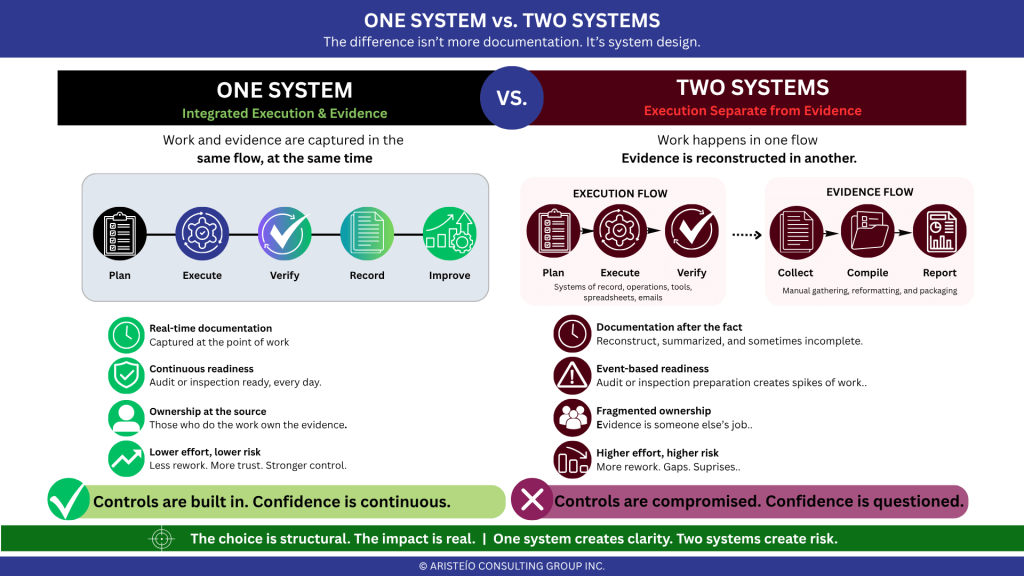
An integrated execution system produces evidence as part of work itself. When traceability, documentation, and control exist outside the operational flow, organizations create parallel systems that increase rework, weaken control, and destabilize execution under pressure.
Why Preparation Exists in the First Place
Preparation does not come from regulation.
It comes from disconnection.
When systems are built for certification, documentation becomes an activity.
It is scheduled, assigned, reviewed—separately from execution.
Operations move forward.
Evidence lags behind.
That gap must eventually be closed.
Preparation is the cost of closing it.
The more the system diverges from real work, the more preparation is required.
This pattern is often amplified as organizations grow. When governance capacity does not evolve with operations, systems fragment—creating the exact conditions where execution and evidence diverge.
Where Evidence Actually Breaks in Real Operations
Evidence does not fail at review points.
It fails during execution.
Changes are applied without traceability.
Decisions are made without records.
Training is completed without linkage to real work.
Corrective actions exist without ownership.
These are not isolated issues.
They are symptoms of a system that separates doing from proving.
Every separation creates divergence.
Every divergence creates reconstruction.
What Breaks First Under Pressure
The system does not collapse immediately.
It fragments.
Capacity visibility disappears.
Leaders cannot see where effort is spent—on work or on compliance.
Governance clarity erodes.
Teams no longer know what must be recorded, or when.
Decision rights blur.
Documentation becomes someone else’s responsibility.
Escalation discipline weakens.
Issues are pushed upward to avoid exposure.
KPI ownership shifts.
Metrics track activity, not control.
Execution continues—but without verifiable truth.
Governance & Ownership Failure
Integration is a leadership decision.
Leaders tolerate two systems when they prioritize certification over execution.
When evidence is produced outside of execution, ownership fragments.
Operators deliver outcomes.
Supervisors validate after the fact.
Quality reconciles inconsistencies.
No role owns truth at the source.
This creates a system that must constantly explain itself.
Control is replaced by verification.
Verification slows execution.
Industry Illustration
In regulated environments, this distinction becomes visible quickly.
One system: execution and evidence are the same
Work produces its own traceability.
Records reflect reality because they are created at the moment of action.
Decisions, changes, and training are captured as they happen—not reconstructed later.
There is no separation between doing and proving.
Readiness is constant because the system is always aligned with itself.
Two systems: execution and evidence are disconnected
Work happens first.
Documentation follows later.
Evidence is rebuilt from memory, interpretation, or fragmented records.
Teams operate one system to deliver—and another to explain what was done.
This creates duplication, delay, and inconsistency.
Readiness becomes an event because truth must be reassembled.
The difference is not regulation.
It is integration.
Organizations don’t struggle with compliance. They operate two systems.
One to deliver.
One to explain.
If those systems are different, your controls are already compromised.
The question is simple:
Do your teams produce evidence as they work—or do they stop working to produce evidence?
Early Warning Signs
Work pauses to “get documentation in order.” This is not preparation. It is reconstruction.
Evidence is created in batches, not continuously. That means the system does not produce truth at the source.
The same gaps reappear across cycles. Because nothing structural has changed.
Compliance workload increases without improving control. Effort rises. Integrity does not.
Teams cannot point to where evidence is generated during execution. Because it isn’t.
What Leaders Commonly Misread
Leaders treat documentation as a compliance layer.
It is not.
It is part of execution.
When treated separately, it becomes additional work.
When integrated, it becomes invisible.
The goal is not better discipline.
It is better system design.
Stabilization Logic
Stability comes from integration.
Governance clarity
Evidence must be defined inside the work, not around it.
At each step, the system specifies what proof is generated, by whom, and at what moment. Ownership sits with the person performing the action—not with a downstream reviewer.
Ambiguity creates gaps. Gaps create reconstruction.
Capacity visibility
You cannot manage what you cannot see.
Separate the effort spent producing value from the effort spent recreating proof. When both are mixed, compliance work hides inside operations and expands silently.
Integrated systems expose where evidence is produced and eliminate duplicate documentation flows.
Decision loop shortening
Decisions are evidence. When decisions are delayed, they are no longer captured in context. They are reconstructed later—often incompletely. This is the same mechanism that creates approval backlogs, where work waits and traceability breaks at the same time.
If they are captured late, they are altered, simplified, or lost. Capture them at the moment they occur, at the level where they are made.
Before (two systems): Decisions are made in meetings, then documented later. Details are reconstructed, ownership is unclear, and approvals create delay.
After (one system): Decisions are captured at the point of action. Context, ownership, and rationale are recorded once, in flow.
Every additional approval layer increases the risk of post-event reconstruction.
Risk surfacing
Gaps must be visible during execution.
If issues are discovered later, the system compensates by building parallel work to explain what happened. Real-time visibility prevents divergence from accumulating.
Delayed visibility creates parallel systems.
Accountability structure
Traceability requires ownership at source.
Each action must carry its own proof—created, validated, and stored within the same flow. When ownership shifts across roles, truth fragments.
One action. One owner. One record.
When systems are integrated, readiness is continuous.
When they are not, preparation becomes necessary.
Why Assessment Comes First
Most organizations cannot see where their system splits.
They see outcomes.
They do not see divergence.
The Resilient Execution Readiness Assessment identifies where execution and evidence separate.
It reveals where work must be explained instead of proven.
It quantifies how much effort is spent maintaining a parallel system.
Without this visibility, organizations optimize the wrong system.
FAQ
Why do some organizations never need to “prepare” for the upcoming audit?
Because their systems are integrated. Work produces traceability in real time, so no reconstruction is required. The absence of preparation is not luck—it is the result of system design.
Why does documentation feel like extra work in most companies?
Because it is treated as a separate activity. When evidence is not embedded in execution and systems, it must be produced afterward. This creates duplication and inefficiency.
Can we reduce preparation without increasing risk?
Yes—by eliminating the gap between execution and evidence. When actions generate their own traceability, separate compliance work disappears while control improves.
Why do systems drift toward parallel structures over time?
Because it is easier to add documentation layers than to redesign execution. Without governance discipline, organizations accumulate workarounds instead of integrating systems.
Call to Action
Organizations do not struggle with compliance.
They struggle with integration.
When execution and evidence are one system, readiness is constant.
they are not, preparation becomes inevitable.
This is not a question of effort.
It is a question of design.
And design can be changed.
About Veronica Marquez, M.Sc., CSSBB

Veronica Marquez is the Founder of Aristeío, a firm specializing in resilient execution systems for manufacturing, service, and public-sector organizations operating under pressure. She works with executive and operations leaders to strengthen governance, clarify decision rights, and surface structural execution risks before they disrupt delivery.
A certified Lean Six Sigma Black Belt with a Master’s degree in Operations Management, Veronica bridges operational rigor with system-level thinking. She was named one of the Top 50 Experts in Operational Excellence by PEX Network and ranked among the Favikon Top 200 Global Creators in Risk & Resilience.
Through her Resilient Execution Readiness Assessment, she helps leadership teams identify and address execution vulnerabilities early—before performance credibility erodes.
Reach out https://www.linkedin.com/in/veronicabm/
📸 Canva AI