



Executive Framing
Approvals are waiting.
Escalations are piling up.
Teams are asking who can decide—and no one answers clearly.
Work doesn’t stop because of regulation.
It slows because decisions don’t move.
Under compliance pressure, organizations don’t lose capacity first. They lose decision velocity—often expressed as growing decision latency across the system.
Where are your decisions getting stuck right now?
Leaders often blame “more controls,” “more requirements,” or “more oversight.”
That diagnosis is wrong.
Compliance doesn’t slow work.
It reveals where decisions were never designed to move.
In regulated environments, execution failure is rarely about effort.
It is about governance design under constraint.
The moment compliance enters the system, every unclear decision right becomes visible.
Every weak escalation path becomes a bottleneck.
Every missing ownership becomes delay.
This is not a compliance problem.
It is a decision system failure.
Clear Definition
A decision system failure under compliance occurs when regulatory requirements expose unclear decision rights, overloaded escalation paths, and fragmented governance structures—resulting in increased decision latency, stalled execution, and reduced operational responsiveness despite unchanged workload.
What Breaks First Under Pressure
Decision Flow Visibility
Teams cannot see where decisions are blocked.
Work appears “in progress” but is actually waiting.
Compliance adds checkpoints.
Weak systems turn checkpoints into blind spots.
Decision Rights Integrity
Roles exist on paper.
Authority does not exist in practice.
When constraints increase, ambiguity increases faster.
Approval authority becomes unclear under pressure.
People hesitate instead of acting.
If compliance changes who can decide, the system was never stable.
Escalation Design Failure
Everything moves upward.
Nothing moves faster.
Escalations accumulate without structure or time limits.
Escalations wait for meeting cycles.
Decisions do not resolve in real time.
Decision Accountability Failure
Decision latency is not measured.
Escalation aging is invisible.
What is not owned does not improve.
These failures are not isolated. They are connected. When compliance pressure increases, decision flow breaks in predictable ways.
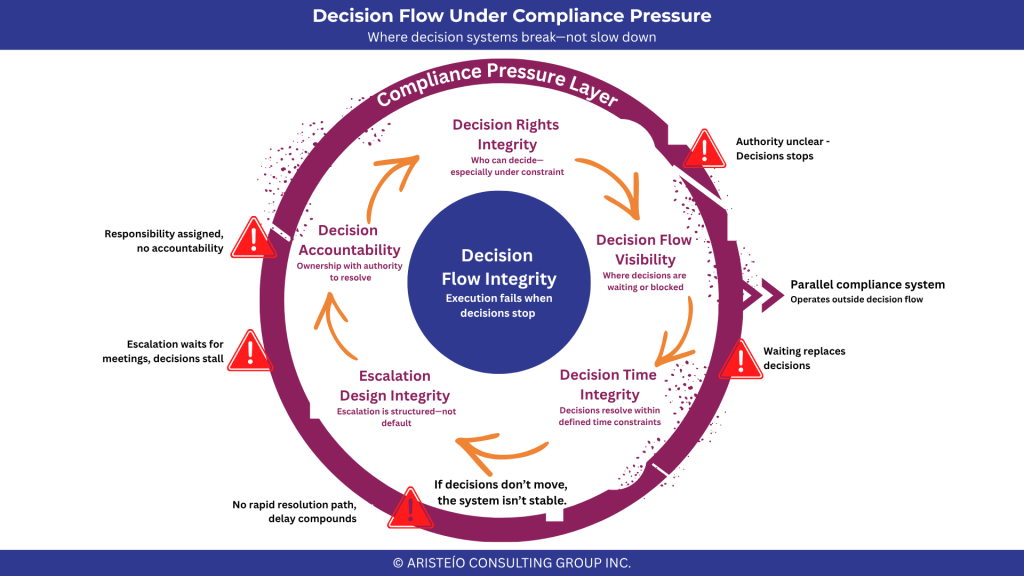
This is not a capacity problem. It is a decision system breakdown.This breakdown shows up first as decision latency across approvals and escalations.
Governance & Ownership Failure
Execution slows when accountability fragments.
Compliance introduces explicit requirements: controls, evidence, traceability.
These force organizations to define who owns what.
Weak systems cannot absorb that pressure.
Decision ownership collapses first.
Escalation ownership disappears next.
System ownership never existed.
Leaders compensate by increasing oversight.
Oversight increases approval layers.
Approval layers increase delay.
The system becomes heavier and slower at the same time.
This is governance inflation.
It feels like control.
It produces paralysis.
Industry Illustration
In Canadian regulated sectors—defence, aerospace, critical minerals—this pattern is predictable.
Compliance requirements are stacking:
security controls, cybersecurity certification, quality systems, traceability expectations.
These do not create complexity.
They expose it.
Organizations are expected to operate like structured enterprises without enterprise capacity.
The result is predictable:
- Decisions move slower at every approval point
- Escalations rise to leadership unnecessarily
- Teams wait instead of acting
The system is not failing because of compliance.
It is failing under visibility.
Evidence requirements force clarity.
Most systems were never designed for that level of clarity.
Early Warning Signs
- Decision cycle time increases without workload increase
- Escalations remain open longer than planned
- Leaders are pulled into routine decisions
- Teams defer decisions “until confirmed”
- Compliance activities delay execution instead of integrating into it
These are not operational issues.
They are governance signals.
What Leaders Commonly Misread
Leaders believe compliance adds work.
It doesn’t.
Compliance adds visibility to weak decision systems.
The misconception is treating regulation as an external burden.
The reality is internal exposure.
A second failure follows.
Compliance is designed outside the system.
Then layered on top of operations.
It becomes a parallel system.
It does not integrate into decision flow.
This is where most compliance initiatives fail—because they operate as a parallel system instead of being embedded into decision flow.
Processes are created for audits—not for decisions.
Controls exist—but do not support flow.
If compliance lives outside your workflows, it will always slow them.
This is where friction accelerates.
Organizations attempt to “manage compliance” with more processes, more approvals, or more documentation.
That approach makes the system slower and weaker.
Compliance is not the problem.
Your decision system is.
What Holds Under Compliance Pressure
Stability under compliance is not achieved through tools.
It is achieved through design.
Decision Rights Integrity
Authority does not change under constraint.
Decisions do not wait for authority clarification.
Decision Flow Visibility
Where decisions are blocked is immediately visible.
Waiting is not hidden inside “work in progress.”
Decision Time Integrity
Decisions resolve within defined time constraints.
Delay is not normalized.
Escalation Design Integrity
Escalation is structured—not default.
It accelerates resolution instead of creating delay.
Decision Accountability
Ownership includes authority to resolve.
Responsibility without decision power is not accountability.
Strong systems do not eliminate control.
They integrate it into decision flow.
Why Assessment Comes First
Most organizations attempt to fix execution without understanding where it breaks.
They add tools.
They add processes.
They add layers.
None of that addresses the system.
Before intervention, three things must be clear:
- Where decision rights collapse under pressure
- Where latency is introduced in the system
- Where escalation paths fail to resolve
Without this clarity, improvements increase complexity.
The Resilient Execution Readiness Assessment exists to map where this system breaks under pressure.
It does not evaluate compliance maturity.
It identifies where the decision system cannot hold under regulatory load.
Clarity precedes speed.
Structure precedes performance.
FAQ
Why does compliance slow down decision-making in organizations?
Compliance does not inherently slow decisions. It exposes unclear decision rights and weak escalation structures. When authority is not explicitly defined under constraint, teams hesitate and escalate unnecessarily, increasing latency. The structural issue is not workload—it is the absence of a designed decision system.
How can organizations maintain speed under regulatory pressure?
Speed is maintained by designing decision rights that hold under constraint. Decisions must be made at the lowest competent level, with clear escalation triggers and time-bound resolution paths. Without this structure, compliance introduces friction because the system cannot absorb visibility.
What is escalation aging and why does it matter?
Escalation aging measures how long unresolved decisions remain in escalation. It is a direct indicator of governance failure. When escalations accumulate without resolution discipline, leadership becomes a bottleneck and execution slows system-wide.
Why do compliance initiatives often fail to improve performance?
They fail because they focus on controls instead of governance. Adding checkpoints without redesigning decision systems increases complexity and delay. Performance improves only when compliance is embedded into execution, not layered on top of it.
Call to Action
If compliance is slowing your execution, the issue is not regulation.
It is the design of your decision system under pressure.
The question is not how to manage compliance.
It is whether your system can hold when constraints increase.
The Resilient Execution Readiness Assessment is designed to answer that question—before visible breakdown occurs.
Execution under pressure is not a capability you train into teams.
It is a system you design.
About Veronica Marquez, M.Sc., CSSBB

Veronica Marquez is the Founder of Aristeío, a firm specializing in resilient execution systems for manufacturing, service, and public-sector organizations operating under pressure. She works with executive and operations leaders to strengthen governance, clarify decision rights, and surface structural execution risks before they disrupt delivery.
A certified Lean Six Sigma Black Belt with a Master’s degree in Operations Management, Veronica bridges operational rigor with system-level thinking. She was named one of the Top 50 Experts in Operational Excellence by PEX Network and ranked among the Favikon Top 200 Global Creators in Risk & Resilience.
Through her Resilient Execution Readiness Assessment, she helps leadership teams identify and address execution vulnerabilities early—before performance credibility erodes.
Reach out https://www.linkedin.com/in/veronicabm/
📸 Canva