



Executive Framing
Approval backlogs are rarely discussed in operational reviews, yet they quietly slow execution when unresolved deviations and approval queues begin to accumulate.
Production capacity increased.
Hiring stabilized.
Orders are still slipping.
Nothing appears broken on the surface. The production line is running. Teams are working. Schedules still look manageable.
Yet delivery performance is unstable. Escalations multiply. Penalties become a recurring discussion.
What is actually blocking progress?
Canadian manufacturing research already links labour shortages to lost sales, late‑delivery penalties, increased operating costs, and employee strain. That reality is widely recognized.
But even when labour stabilizes, many organizations continue to struggle.
Because the constraint has shifted.
Not on the shop floor. In the exception queue.
Quality deviations waiting for disposition. Supplier issues awaiting approval. Compliance questions pending clarification. Operational decisions delayed while exceptions remain unresolved.
Individually, none of these stop production.
Collectively, they slow the entire organization.
Approval backlogs and unresolved deviations quietly inflate operational lead time.
Teams compensate by working around unresolved issues. Leaders intervene only after delivery risk becomes visible. Firefighting becomes routine because exceptions are not resolved fast enough.
We’re thorough — but contracts are bleeding.
This is not a productivity problem.
It is a structural one.
When exception resolution does not scale with operational volume, execution slows regardless of available capacity.
Approval backlogs and unresolved deviations become the constraint.
Clear Definition
Approval backlog and unresolved deviations refer to the accumulation of operational issues—such as deviations, approval requests, supplier discrepancies, or compliance questions—that remain open longer than operational timelines can tolerate. When these issues age without resolution, they quietly inflate lead time and destabilize delivery performance.
Exceptions are part of operations. Aging approvals and deviations create risk.
What Breaks First Under Pressure
Under stable conditions, exception resolution often feels manageable. Teams resolve issues informally, and production continues moving.
Pressure changes the equation.
Capacity Visibility
(For a deeper look at how organizations govern and allocate capacity, see our article on When Strategy Outpaces Governance Capacity)
Most organizations track production backlog carefully.
Few track approval backlog or aging deviations.
Deviations accumulate. Approval requests age. Compliance questions circulate across functions waiting for clarification.
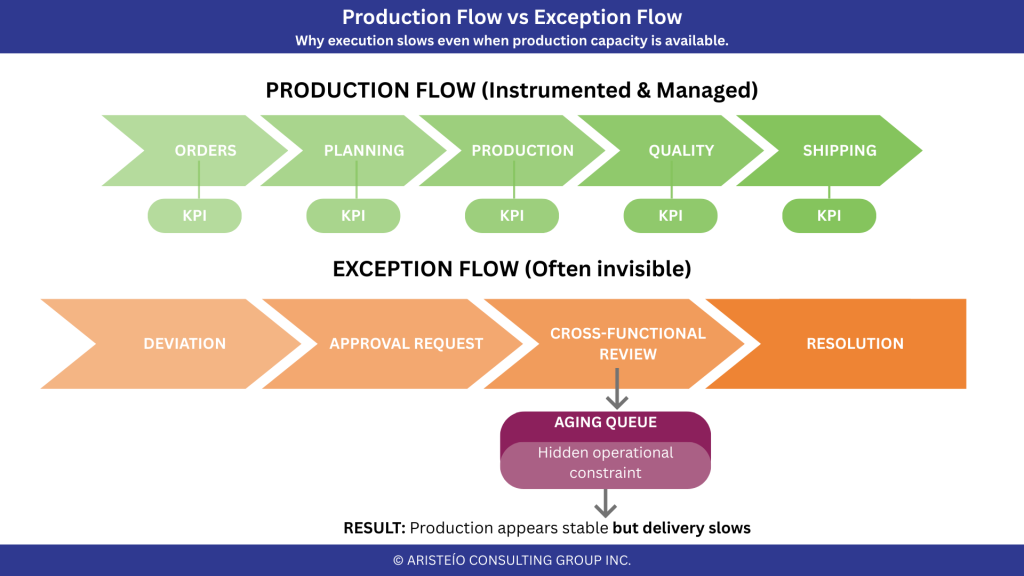
The queue grows without visibility.
Invisible queues distort operational lead time.
Governance Clarity
Who is responsible for resolving an exception?
At what point must it escalate?
When governance rules are vague, exceptions circulate between teams. Each handoff adds delay without creating resolution.
Clarity reduces delay.
Decision Rights
Many exceptions require cross‑functional input. Quality, engineering, operations, supply chain, and compliance may all participate.
But participation is not ownership.
When decision rights are unclear, no one owns the clock.
Escalation Discipline
(This issue is closely related to escalation design discussed in our article on Capacity Governance Under Pressure)
Exceptions that age beyond tolerance should escalate automatically.
In many organizations, escalation happens informally—after schedules are already affected.
Late escalation amplifies operational disruption.
KPI Ownership
Exception resolution time is rarely measured at executive level.
Yet it directly shapes schedule adherence.
What is not measured cannot stabilize.
Governance & Ownership Failure
Approval backlog rarely forms because people ignore problems.
It forms because ownership is diffused.
An issue appears in production. It moves to quality for review. It moves to engineering for interpretation. It returns to operations for clarification. It waits for compliance confirmation.
Everyone contributes, yet responsibility for resolving the issue remains unclear. As the problem moves across functions, additional reviews are introduced to ensure thoroughness and reduce risk. The intention is understandable, but each added layer extends the time required to reach a decision. Over time, the organization becomes more careful yet slower to respond. Without clear governance and ownership, thoroughness gradually turns into latency that slows execution.
Industry Illustration
In regulated environments—such as aerospace, defence, medical manufacturing, or energy supply chains—exceptions are unavoidable.
Documentation requirements are strict. Traceability is essential. Compliance risk is real.
These environments generate deviations, approvals, and regulatory clarifications as part of normal operations.
The issue is not the presence of exceptions.
The issue is how quickly they are resolved.
When resolution pathways are unclear, exceptions accumulate faster than they close.
Operational lead time expands even when production capacity is unchanged.
Aging approvals and unresolved deviations inflate execution latency just as excess work‑in‑progress inflates production flow.
Few organizations instrument this queue.
Early Warning Signs
- Deviations or exceptions remain open across multiple production cycles.
- Teams frequently work around unresolved issues to keep production moving.
- Escalations occur only after delivery impact becomes visible.
- Approval requests circulate across departments without clear ownership.
- Leaders intervene repeatedly to resolve individual cases.
These are structural signals.
What Leaders Commonly Misread
Many executives assume operational instability reflects workload pressure or staffing shortages.
Operational instability is often attributed to volume or staffing pressure, yet persistent delays usually reflect how the organization is designed to resolve issues. When approval backlogs and unresolved deviations begin to grow, many organizations respond by adding additional review layers in an effort to reduce risk. While this additional oversight can feel prudent, it often lengthens the time required to reach resolution and leaves ownership unclear. Over time, the system becomes more controlled but less responsive, allowing backlogs to grow rather than resolve.
Stabilization Logic
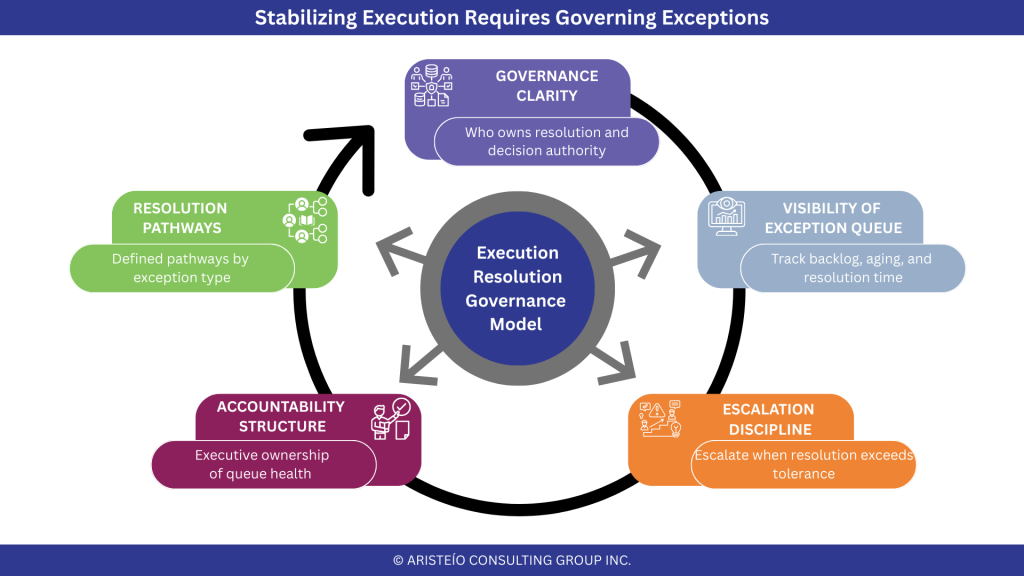
Stabilizing execution requires governing how operational exceptions are resolved. The five elements below form the structural system that prevents approval backlogs and unresolved deviations from becoming operational constraints.
Why Assessment Comes First
Most organizations do not measure approval backlog or aging deviations.
They measure production output, schedule adherence, and financial results.
But they cannot see the queue slowing the system.
The Resilient Execution Readiness Assessment surfaces these hidden structural constraints.
It examines how exceptions are identified, owned, escalated, and resolved across the organization.
The objective is clarity.
Intervention without diagnosis usually produces more controls and additional approval layers.
Clarity reveals where governance design must evolve.
FAQ
What are approval backlogs and unresolved deviations in operations?
Approval backlog and unresolved deviations refer to operational issues—such as deviations, approvals, or compliance questions—that remain open while work continues around them. When resolution speed lags behind operational demand, these issues accumulate and quietly extend operational lead time.
Why do exceptions accumulate in regulated industries?
Regulated industries generate more deviations and compliance questions due to strict documentation and traceability requirements. Without clear governance and ownership for resolution, these issues circulate across functions and remain open longer than operational timelines can tolerate.
How does exception backlog affect delivery performance?
When unresolved exceptions accumulate, teams compensate by working around incomplete decisions or unresolved issues. This increases operational risk and slows execution. Over time, schedule adherence declines and delivery penalties become more likely.
Can organizations eliminate exceptions entirely?
No. Exceptions are a normal part of complex operations. The objective is not elimination but rapid resolution. Organizations that design clear ownership and escalation for exceptions prevent backlog from forming and maintain execution stability.
Call to Action
If delivery performance is unstable despite available capacity, the constraint may not be production.
It may be the unresolved issues slowing the system.
Understanding how exceptions accumulate—and how quickly they are resolved—reveals structural risks that traditional operational metrics rarely capture.
The Resilient Execution Readiness Assessment helps organizations surface these hidden constraints and redesign governance before instability becomes chronic.
Execution stability is not a matter of effort.
It is a matter of design.
About Veronica Marquez, M.Sc., CSSBB

Veronica Marquez is the Founder of Aristeío, a firm specializing in resilient execution systems for manufacturing, service, and public-sector organizations operating under pressure. She works with executive and operations leaders to strengthen governance, clarify decision rights, and surface structural execution risks before they disrupt delivery.
A certified Lean Six Sigma Black Belt with a Master’s degree in Operations Management, Veronica bridges operational rigor with system-level thinking. She was named one of the Top 50 Experts in Operational Excellence by PEX Network and ranked among the Favikon Top 200 Global Creators in Risk & Resilience.
Through her Resilient Execution Readiness Assessment, she helps leadership teams identify and address execution vulnerabilities early—before performance credibility erodes.
Reach out https://www.linkedin.com/in/veronicabm/
📸 Canva