



Key Takeaways
- Innovation garners attention, but capability fosters adoption and builds trust among defence customers.
- The Trusted Capability Framework emphasizes the importance of organizational readiness, reliable delivery, and evidence to secure customer confidence.
- Defence customers evaluate not only the solutions but also the ability of organizations to consistently deliver results.
- To gain trust, organizations must demonstrate strong processes, skilled personnel, and compliance with security requirements.
- Operational maturity assessments help organizations identify capability gaps and prepare for new opportunities in the defence sector.
Estimated reading time: 11 minutes
Innovation Gets You Noticed. Capability Gets You Adopted.
A Consistent Message Across Defence Events
Across recent defence ecosystem events, procurement webinars, Industrial and Technological Benefits (ITB) discussions, cybersecurity briefings, and industry conferences, a recurring message emerged.
Innovation attracts attention.
Capability creates confidence.
Although speakers approached the topic from different perspectives, the underlying message was remarkably consistent:
Defence customers are not evaluating innovation alone. They are evaluating whether an organisation can consistently deliver outcomes.
Recent discussions on defence procurement highlighted supplier readiness, delivery capability, and long-term support.
Cybersecurity and industrial security presentations emphasised trust, risk reduction, and organisational preparedness.
ITB discussions reinforced the importance of resilient supply chains and industrial capacity.
Taken together, these observations point to a broader reality.
Customers appear to evaluate organisations as much as they evaluate solutions.
Why Innovation Alone Is Not Enough
Innovation plays an important role.
It creates visibility.
It starts conversations.
It demonstrates potential value.
However, innovation alone rarely determines adoption.
Customers often ask broader questions:
- Can this organisation deliver consistently?
- Can it meet demanding requirements?
- Can it manage growth?
- Can it protect sensitive information?
- Can it support long-term performance?
- Can it respond effectively to disruption?
These questions shift the conversation away from innovation and toward organisational capability.
The challenge is no longer whether an idea is promising.
The challenge becomes whether the organisation can be trusted to deliver on that promise.
Innovation may create interest.
Capability creates confidence.
The Key Question
This observation should sound familiar to leaders responsible for operational excellence, supply chain performance, organisational resilience, and sustainable growth.
Success rarely depends solely on the strength of an idea.
Long-term success depends on an organisation’s ability to execute.
This raises an important question:
What organisational capabilities must exist before a defence customer trusts a solution?
One way to explore that question is through the lens of Trusted Capability.
Insights Behind the Framework
Defence Procurement Discussions
The Trusted Capability Framework did not emerge from a single event or presentation.
It evolved through recurring themes observed in defence procurement discussions and industry webinars.
Supplier readiness was a common topic.
Long-term delivery capability emerged repeatedly.
Several speakers emphasised that customers are evaluating the organisation behind the solution, not only the solution itself.
Cybersecurity and Security Readiness Discussions
Cybersecurity and industrial security briefings highlighted another recurring theme.
Trust must be earned.
Security requirements are increasingly becoming business requirements.
Organisations must demonstrate that they can protect information, manage risk, and maintain operational discipline.
These expectations often influence participation long before a contract is awarded.
Supply Chain and ITB Discussions
Industrial and Technological Benefits discussions frequently focused on industrial capacity and supply chain readiness.
These conversations highlighted the importance of:
- Reliable suppliers
- Resilient networks
- Long-term delivery capability
- Sustainable industrial participation
Capability increasingly depends on the performance of the broader ecosystem.
Operational Excellence Observations
Many of these observations align closely with lessons from operational excellence and supply chain transformation initiatives.
High-performing organisations tend to have:
- Strong processes
- Clear accountability
- Continuous improvement capabilities
- Reliable delivery systems
- Resilient supply chains
The terminology may differ across sectors.
The underlying principles are often remarkably similar.
A Common Thread
Across these discussions, one message continued to surface.
Customers may notice innovation.
However, they adopt organisations they trust.
Trust is built through capability.
Capability is reinforced through evidence.
The Trusted Capability Framework was developed as a way to visualise that relationship.
The Trusted Capability Framework
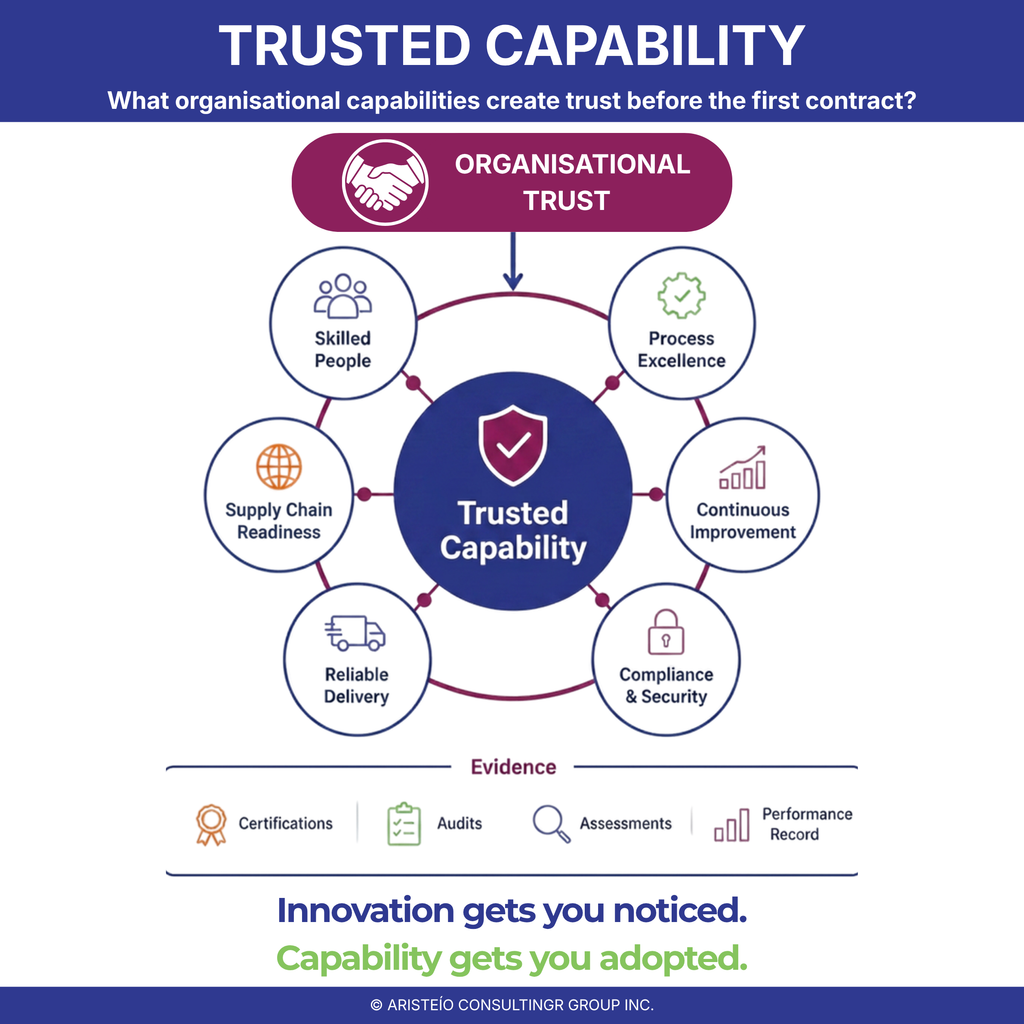
The framework is built around three interconnected elements:
- Organisational Trust
- Trusted Capability
- Evidence
Together, these elements help explain how organisations move from awareness to adoption.
Organisational Trust
Organisational Trust sits at the top of the framework.
It reflects confidence in an organisation’s ability to consistently deliver on its commitments.
Trust develops through:
- Reliability
- Transparency
- Consistency
- Accountability
- Performance
Without trust, capability is difficult to recognise.
Trusted Capability
Trusted Capability represents the operational capabilities that support reliable execution.
These capabilities help organisations deliver results consistently, even in demanding environments.
Skilled People
Capability starts with people.
Organisations need individuals with the knowledge, skills, and experience required to perform consistently and adapt to changing requirements.
Strong teams improve execution.
Strong teams also improve resilience.
Process Excellence
Reliable outcomes require reliable processes.
Process excellence helps organisations improve:
- Consistency
- Quality
- Scalability
- Efficiency
- Performance visibility
Strong processes reduce uncertainty.
Consequently, they strengthen confidence.
Continuous Improvement
Requirements evolve.
Markets change.
Risks emerge.
Organisations that continuously improve are better positioned to adapt and sustain performance over time.
Continuous improvement helps transform short-term success into long-term capability.
Compliance and Security
Recent defence discussions repeatedly highlighted the importance of compliance and security.
These capabilities are increasingly becoming foundational expectations.
Strong controls support:
- Risk management
- Information protection
- Governance
- Customer confidence
They also contribute directly to organisational trust.
Reliable Delivery
Customers ultimately judge organisations by outcomes.
Reliable delivery demonstrates an organisation’s ability to transform commitments into results.
Promises may create expectations.
Consistent delivery builds confidence.
Supply Chain Readiness
No organisation operates in isolation.
Supply chain readiness influences:
- Responsiveness
- Reliability
- Continuity
- Resilience
This is particularly important in environments where performance depends on a network of suppliers and partners.
Evidence
Evidence validates capability.
Claims may create interest.
Evidence creates confidence.
The stronger the evidence, the easier it becomes to establish trust.
Certifications
Certifications demonstrate that recognised requirements have been met.
They help provide assurance that systems and controls are in place.
Audits
Audits provide independent verification.
They help validate that processes are functioning as intended.
Assessments
Assessments identify strengths, gaps, risks, and opportunities for improvement.
They provide valuable insight into organisational readiness.
Performance Records
Past performance often provides the strongest evidence of future capability.
Performance records demonstrate an organisation’s ability to consistently deliver results.
How the Framework Works
Each element reinforces the others.
Capability helps create trust.
Evidence validates capability.
Trust increases confidence.
Together, these elements help organisations move from initial interest to long-term adoption.
The framework does not suggest that innovation is unimportant.
Rather, it suggests that innovation alone is rarely sufficient.
Why Trusted Capability Matters
Trust Reduces Risk
Customers make decisions under uncertainty.
Trust helps reduce that uncertainty.
When organisations demonstrate strong operational capability, customers gain confidence that commitments can be fulfilled.
Capability Creates Confidence
Capability provides reassurance that performance can be sustained.
This includes the ability to:
- Deliver consistently
- Manage complexity
- Respond to disruption
- Improve continuously
Capability transforms potential into confidence.
Evidence Supports Adoption
Evidence helps validate claims.
It reduces uncertainty.
It supports decision-making.
Certifications, audits, assessments, and performance records all contribute to stronger confidence.
From Interest to Adoption
Innovation creates awareness.
Capability creates confidence.
Evidence creates trust.
Together, these elements help organisations move from being noticed to being adopted.
Building Capability in Complex Markets
Operational Excellence
Operational excellence strengthens execution.
It improves consistency, accountability, and performance discipline.
Organisations with mature operational systems are often better positioned to support growth and respond to demanding customer expectations.
How to Unlock Employee-Driven Operational Excellence
Supply Chain Resilience
Resilient supply chains improve reliability.
They also improve responsiveness under changing conditions.
This capability becomes increasingly important as organisations pursue opportunities in complex markets.
Continuous Improvement
Continuous improvement helps organisations adapt to evolving customer expectations.
It also supports long-term competitiveness and resilience.
Why Continuous Improvement Is the Key to Productivity
Business Agility
Agility helps organisations respond effectively to uncertainty.
This capability allows organisations to adjust without losing control or performance.
From Psychological Safety to Operational Resilience
Sustainable Growth
Growth creates opportunities.
However, growth without capability can create risk.
Sustainable growth requires strong operational foundations.
Building Readiness Before Opportunity Appears
Many organisations focus on opportunity first and capability second.
However, readiness often determines how successfully opportunities can be captured.
Customers frequently evaluate organisational maturity long before they evaluate contract performance.
Operational Excellence Lessons for Defence
Manufacturing and Transportation Share Similar Challenges
Manufacturing and transportation organisations routinely face challenges involving:
- Reliability
- Quality
- Scalability
- Supply chain performance
- Workforce capability
These sectors provide valuable lessons about building resilience and sustaining performance over time.
Capability Creates Confidence
Across complex industries, confidence is built through consistent execution.
Customers tend to trust organisations that repeatedly demonstrate they can deliver on commitments.
This principle appears equally relevant in defence-related discussions.
Defence Makes These Requirements Visible
Defence environments bring unique operational and security considerations.
However, many of the underlying organisational challenges are familiar.
Organisations must:
- Deliver consistently
- Manage risk
- Build resilient supply chains
- Develop strong processes
- Demonstrate performance
The difference is that defence makes these requirements highly visible and often non-negotiable.
Frequently Asked Questions
Defence customers seek confidence that an organisation can consistently deliver, support, and sustain outcomes. Innovation may generate interest, but capability reduces risk and uncertainty.
Defence customers seek confidence that an organisation can consistently deliver, support, and sustain outcomes. Innovation may generate interest, but capability reduces risk and uncertainty.
Organisational trust develops through strong processes, skilled people, reliable delivery, governance, supply chain readiness, and demonstrated performance.
Evidence may include certifications, audits, assessments, performance records, operational results, and customer references.
Organisations can strengthen Trusted Capability through operational excellence, supply chain resilience, continuous improvement, governance, workforce development, and evidence-based performance measurement.
No.
Trusted Capability is relevant in any environment where reliability, resilience, risk management, and long-term performance matter.
How Ready Is Your Organisation?
Operational Maturity Assessment
Innovation may create opportunities.
Capability determines whether organisations can capture them.
The Trusted Capability Framework highlights several capabilities that contribute to customer confidence.
However, understanding current strengths and gaps often requires a structured assessment.
What the Assessment Evaluates
The Operational Maturity Assessment evaluates the systems, behaviours, and capabilities that influence organisational performance and readiness.
Among other areas, the assessment examines:
- Leadership and communication
- Performance management and productivity
- Management systems and governance
- Strategy execution and KPI alignment
- Continuous improvement and innovation
- People development and team effectiveness
- Agility and organisational resilience
- Supply chain execution
- Capacity planning
- Technology maturity and enablement
The assessment also explores how these elements work together to support sustainable growth, operational excellence, resilience, and long-term organisational performance.
Identifying Capability Gaps
The assessment helps organisations identify areas that may require additional investment, development, or improvement.
Understanding these gaps can support more informed decision-making and stronger readiness.
Preparing for New Opportunities
Whether the objective is entering defence markets, improving operational performance, strengthening resilience, or supporting growth, understanding organisational maturity provides valuable insight into current strengths and capability gaps.
For organisations exploring defence opportunities, operational maturity can provide a useful indicator of readiness.
Customers may evaluate products and services.
However, they also evaluate the organisation behind them.
Understanding organisational maturity helps create a clearer picture of both strengths and opportunities for improvement.
Innovation gets organisations noticed. Operational maturity helps turn capability into confidence.
Conclusion
The Key Takeaway
Innovation matters.
It creates visibility.
It sparks conversations.
It generates interest.
However, adoption requires more.
Customers must believe that an organisation can consistently deliver on its promises.
Looking Beyond Innovation
The Trusted Capability Framework suggests that confidence emerges when organisational trust, operational capability, and evidence reinforce one another.
This insight was reinforced through discussions across procurement events, cybersecurity briefings, Industrial and Technological Benefits sessions, supply chain forums, and conversations with defence-sector practitioners.
Although the language varied, the message remained remarkably consistent.
Organisations are judged not only by what they create.
They are judged by what they can reliably deliver.
That reality extends beyond defence.
However, defence environments make it particularly visible.
Innovation gets organisations noticed.
Trusted Capability gets them adopted.
Sources and Industry Insights
Defence Procurement Discussions
Insights gathered through defence procurement webinars and industry discussions focused on supplier readiness, long-term delivery capability, and adoption considerations.
ITB and Supply Chain Discussions
Observations from Industrial and Technological Benefits discussions highlighting industrial participation, supply chain resilience, and capability development.
Cybersecurity and Industrial Security Presentations
Presentations focused on cybersecurity, industrial security, organisational trust, and readiness requirements.
Defence Capability Discussions
Industry presentations and discussions examining capability gaps, readiness, resilience, and adoption challenges.
Operational Excellence and Supply Chain Transformation Engagements
Operational excellence, resilience, and supply chain transformation experience across manufacturing, transportation, and other complex operating environments contributed to the development of the Trusted Capability Framework.

About Veronica Marquez, M.Sc., CSSBB

Veronica Marquez is the Founder of Aristeío, a firm specializing in resilient execution systems for manufacturing, service, and public-sector organizations operating under pressure. She works with executive and operations leaders to strengthen governance, clarify decision rights, and surface structural execution risks before they disrupt delivery.
A certified Lean Six Sigma Black Belt with a Master’s degree in Operations Management, Veronica bridges operational rigor with system-level thinking. She was named one of the Top 50 Experts in Operational Excellence by PEX Network and ranked among the Favikon Top 200 Global Creators in Risk & Resilience.
Through her Resilient Execution Readiness Assessment, she helps leadership teams identify and address execution vulnerabilities early—before performance credibility erodes.
Reach out https://www.linkedin.com/in/veronicabm/